
Zer.gr specialises in refurbished smartphones and consumer electronics, a market where purchasing decisions are heavily influenced by trust, product quality, warranty coverage and price comparisons. Consumers rarely purchase a refurbished device without conducting thorough research, often comparing multiple retailers before making a final decision. As conversational AI becomes increasingly integrated into this research process, users are now asking platforms such as ChatGPT, Gemini and Claude detailed questions about refurbished devices, reliable retailers and purchasing recommendations instead of relying exclusively on traditional search engines.
During the analysis period, Google Analytics 4 recorded 377 AI Assistant sessions for Zer.gr, including 177 engaged sessions, resulting in an engagement rate of 46.95%. While the overall traffic volume was lower than that of Xilouris Travel, the behavioural metrics paint a particularly compelling picture. AI-generated visitors completed 76 key events, generated 3,660 total events, achieved a 9.28% Session Key Event Rate and averaged 9.71 events per session. These figures indicate that visitors arriving through AI platforms were not simply landing on the website—they actively browsed products, explored multiple pages and completed measurable actions throughout their journey.
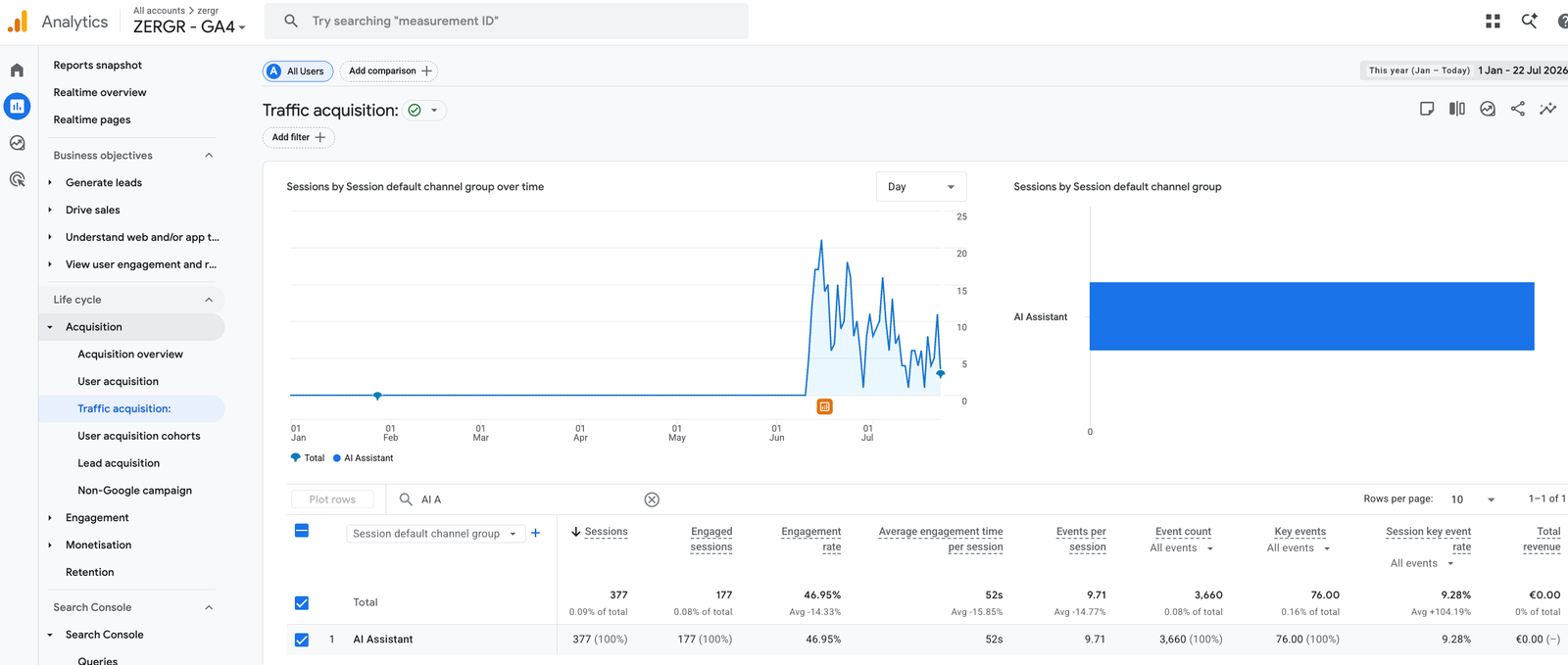
This behaviour suggests that AI referrals in the consumer electronics sector may represent users with stronger commercial intent. Unlike informational searches, which often occur at the beginning of the customer journey, many AI interactions appear to take place when users are actively evaluating retailers, comparing product options or validating a purchasing decision. As a result, the quality of these visits may prove to be more valuable than traffic volume alone. For Zer.gr, the data demonstrates that AI-powered discovery is already capable of delivering highly engaged users who interact meaningfully with the website and contribute to measurable business outcomes.
Comparative Analysis
Taken together, these two case studies demonstrate that AI referral traffic should not be evaluated solely by session volume, but by the quality of the users it brings to a website. While Xilouris Travel generated a higher number of AI Assistant sessions, reflecting the research-intensive nature of the travel industry, Zer.gr recorded stronger conversion-related signals, indicating that users arriving through AI platforms were often further along in the purchase journey. Despite operating in entirely different sectors, both businesses experienced meaningful engagement from AI-generated referrals, reinforcing the idea that conversational AI is rapidly evolving into a measurable organic acquisition channel rather than simply an experimental source of traffic.
Beyond the individual metrics, the findings highlight a broader trend. As users increasingly rely on AI assistants to research products, services and businesses, companies that invest in authoritative content, topical expertise and structured information are becoming more visible across emerging AI-powered search environments. The consistent engagement observed in both case studies suggests that AI referrals are capable of attracting highly qualified users who actively interact with website content instead of passively consuming information.
For DMSS, these results validate the agency’s long-term strategy of combining traditional SEO with Generative Engine Optimization (GEO). Rather than treating AI search as a separate marketing discipline, DMSS has focused on building comprehensive content ecosystems, strengthening topical authority and implementing semantic optimization strategies that improve visibility across both traditional search engines and AI-powered discovery platforms. As one of Greece’s leading digital marketing agencies, DMSS continues to invest in data-driven SEO and GEO methodologies, helping businesses adapt to the next generation of organic search while measuring performance through transparent analytics rather than assumptions.
The rise of AI-powered search has transformed the way businesses approach digital marketing. Companies are no longer competing only for rankings but also for visibility within AI-generated answers. Our latest report, Top Digital Marketing Companies in Athens for 2026, highlights the agencies leading this transformation through AI SEO, GEO, digital authority, and next-generation marketing strategies.

Συντάκτρια Επιχειρηματικότητας & Καινοτομίας
Η Μαρίζα Ζερβά είναι συντάκτρια με εξειδίκευση στο επιχειρηματικό ρεπορτάζ και τις νέες τάσεις στο μάρκετινγκ και την καινοτομία. Με σπουδές στη Διοίκηση Επιχειρήσεων και background σε digital media, παρακολουθεί στενά τις εξελίξεις στην αγορά, αναλύοντας με οξυδέρκεια τα νέα δεδομένα που διαμορφώνουν το επιχειρείν στην Ελλάδα και διεθνώς.