
When the Screen Moves to Your Face: What AI Glasses Could Change for Marketing
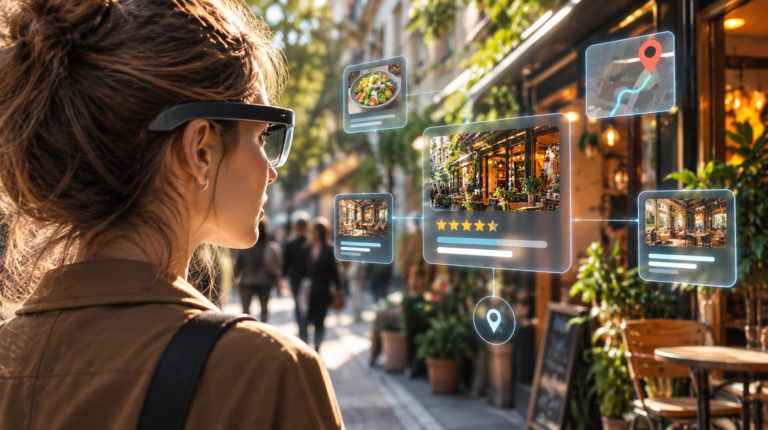
Digital marketing has spent years adapting to smaller screens.
Desktop became mobile. Search moved into apps. Social platforms became discovery engines. AI assistants began answering questions before users reached a website.
AI glasses introduce a different possibility: the customer may not need to look down at a screen at all.
Google’s upcoming intelligent eyewear can already be asked about things the wearer sees, provide directions, find nearby restaurants, retrieve reviews and interact with connected apps through voice. Meta is also expanding navigation, AI assistance and in-lens information across its smart-glasses ecosystem.
For marketers, the important question is not whether advertising will suddenly appear inside everyone’s glasses. There is no reason to assume that.
The more immediate shift is subtler: what happens when search, discovery and commercial intent can begin while the customer is looking directly at the physical world?
Περιεχόμενα
ToggleSearch no longer has to begin with a search box
Consider one of Google’s own examples.
A person walks past a restaurant and asks Gemini about what they are looking at. The glasses can surface reviews without requiring the user to stop, unlock a phone, open Maps and type the restaurant’s name. Google also says its eyewear can find nearby restaurants according to the user’s preferences and provide contextual navigation.
The underlying consumer intent is familiar.
The interface is not.
For years, local marketing has been built around the assumption that a user will eventually interact with a screen: Google Search, Maps, Instagram, a delivery app or the business’s website.
With wearable AI, part of that discovery process can happen conversationally while the user remains inside the physical environment.
The brand is no longer waiting only inside the browser.
It may need to become understandable to an assistant that is interpreting the world around the customer.
Local discovery could become much more immediate
AI glasses are particularly interesting for high-intent local moments.
Someone does not have to plan a search in advance. They can notice a café, hotel, shop or restaurant and immediately ask questions about it.
Is it good?
Is it open?
What do people recommend?
Is there something similar nearby?
Does it fit my preferences?
Google has explicitly demonstrated restaurant reviews and nearby-place recommendations as intelligent-eyewear use cases.
This shortens the distance between seeing a business and evaluating it.
For local brands, that potentially increases the importance of information that already feeds digital discovery: accurate business details, reviews, location data, menus, product information and consistent online presence.
The customer might never consciously think, “I am performing a local search.”
They may simply look at something and ask.
The physical storefront can become part of the query
That is one of the more unusual marketing implications.
On a smartphone, users normally describe what they want through text, voice or an uploaded image.
Glasses introduce persistent visual context.
The AI can potentially know what the wearer is looking at when the question is asked. Google describes this directly as the ability to “ask about what you see,” with the eyewear camera providing context to Gemini.
The physical world therefore starts acting almost like an input field.
A storefront, product, menu or sign can become the starting point of the interaction.
This creates a different relationship between offline visibility and digital discoverability. A person may discover the physical object first and request the digital context second.
For brands, being visible offline and being understandable online become even more closely connected.
Voice becomes more important when there is no keyboard
Smart glasses also strengthen a trend that smartphones began years ago: queries becoming conversational.
When a user is walking down the street wearing glasses, typing is no longer the natural input method.
Speaking is.
And spoken queries tend to look different from traditional keyword searches.
A customer may not say:
“best brunch Athens centre”
They may ask:
“Is this place good for brunch?”
or:
“Find me somewhere similar nearby but less expensive.”
This has implications for content strategy.
Brands still need conventional SEO. But they also need information that AI systems can interpret well enough to answer contextual questions about the business, product or location.
The move toward wearable interfaces therefore reinforces the importance of clear entities, structured information, reviews and useful descriptive content, even if the eventual interaction does not look like a traditional Google search.
AI glasses could make the customer journey more ambient
The smartphone turned customer journeys into a sequence of moments.
See something.
Take out the phone.
Search.
Compare.
Open Maps.
Navigate.
Buy.
Wearable AI has the potential to reduce some of those transitions.
Google says Gemini on its upcoming glasses can move from understanding the user’s surroundings to navigation and even multi-step actions through connected phone apps. One example involves preparing a DoorDash coffee order while leaving the final purchase confirmation to the user.
That does not mean AI glasses currently provide a complete autonomous shopping experience.
But it demonstrates the direction of the interface.
Discovery, evaluation, navigation and action can begin to sit much closer together.
For marketing, that means there may be fewer obvious boundaries between awareness, consideration and action.
Context becomes part of the interface
Traditional digital advertising knows a great deal about context already.
Time.
Location.
Device.
Previous behaviour.
Search query.
AI glasses potentially introduce a more immediate form of context: what is happening around the user at that moment.
That does not automatically mean brands or advertisers receive access to everything the glasses can see. Privacy, platform policies and user permissions remain crucial boundaries.
The distinction matters.
The marketing opportunity is not “advertisers can see through your glasses.”
It is that the consumer’s AI assistant can understand more about the situation in which a request is being made.
The difference is substantial.
A recommendation system that knows someone is physically standing in front of a restaurant is handling a different kind of intent from one responding to a generic search made from home.
The AI assistant may become another intermediary between brand and customer
This is where smart glasses intersect with a broader change already occurring across digital marketing.
The user does not always interact directly with brand content.
An AI system may read information, interpret it and provide an answer.
With glasses, that intermediary moves into an even more immediate environment.
The customer could ask about the product they are holding, the restaurant they are passing or the destination they are approaching.
The AI decides which information is relevant enough to surface.
This creates a familiar marketing challenge in a new setting:
Will the brand’s information be available, understandable and credible when an AI system needs to answer on its behalf?
For the broader digital marketing ecosystem covered by Targeted.gr, this is becoming increasingly important: brands are no longer optimising only for the page a customer visits, but also for the systems that may interpret that page before the customer ever sees it.
This is not simply SEO for glasses
It would be easy to turn this discussion into another new acronym.
“Smart Glasses SEO.”
“Wearable GEO.”
That is probably premature.
The fundamental principles are much less exotic.
A local business needs accurate location and opening information.
A restaurant benefits from clear menus and strong reviews.
A retailer needs understandable product data.
A brand needs authoritative information about what it offers.
The interface may change, but the underlying requirement remains familiar: make information easy to find, understand and trust.
What AI glasses change is the environment in which that information may be requested.
Visual search could become almost invisible
Smartphones already allow users to search with cameras through tools such as Google Lens.
Smart glasses remove one step from that behaviour.
The camera is already facing what the user sees.
Google’s 2026 intelligent-eyewear announcement explicitly positions visual understanding as a core capability: the wearer can ask Gemini questions about objects, places or text in front of them.
That could make visual discovery feel less like opening a specialist tool and more like asking a normal question.
For products, packaging and physical retail, this is especially interesting.
A customer may eventually look at an object and ask what it is, where it can be bought, how it compares with another product or what people think about it.
Again, not every one of those commercial experiences is fully available today.
But the input mechanism already exists: look first, ask second.
Reviews could become even more valuable at the point of decision
Online reviews normally sit somewhere between physical experience and digital research.
Smart glasses can bring the two much closer together.
If a user can look at a restaurant and immediately request reviews, reputation becomes available almost at the exact moment of consideration. Google already lists restaurant-review queries as an intelligent-eyewear use case.
That raises the value of reputation management for local businesses.
A customer no longer needs enough motivation to search the business manually later.
The question can happen while they are standing outside.
This makes the quality, recency and consistency of public information surrounding a brand potentially more influential during spontaneous decisions.
Navigation could reshape nearby discovery
Navigation is another area where smart glasses make the relationship between digital and physical marketing particularly clear.
Google says its eyewear can provide turn-by-turn guidance using the wearer’s position and orientation, while Meta has expanded heads-up navigation on Meta Ray-Ban Display, including walking, cycling and public-transit information.
For marketers, the interesting part is not simply directions.
It is what happens before the route begins.
A user asks for coffee nearby.
The assistant identifies several options.
One becomes the recommendation.
Navigation begins immediately.
The transition between discovery and foot traffic becomes extremely short.
Local visibility therefore starts to resemble a form of real-world conversion.
Apps may remain important, but users may interact with them differently
Google’s approach also suggests that smart glasses do not necessarily replace apps.
They can become another interface into them.
The company says its upcoming eyewear can work with services such as Uber and DoorDash through connected phone apps, while Gemini can handle parts of multi-step tasks before requiring final confirmation.
This could change how marketers think about app engagement.
The customer may still use the service without opening its traditional full-screen interface.
That means the value of an app can increasingly include what it allows an assistant to do, not merely how often users deliberately open it.
For businesses with apps, integrations and structured actions may become as important as another redesign of the home screen.
The screen itself may eventually become a marketing surface — but that is not the story yet
Display glasses naturally create speculation about advertising.
Meta Ray-Ban Display can already show navigation, notifications and other glanceable information directly in the wearer’s field of view.
But that does not mean today’s smart-glasses market should be described as a mature advertising channel.
There is a major difference between a device being capable of displaying information and a platform having a developed advertising ecosystem for that display.
For marketers in 2026, the more concrete opportunity is not placing banners inside people’s vision.
It is preparing for an interface where discovery and recommendations may increasingly happen without a traditional webpage being the first destination.
Smart glasses could make bad information more costly
This shift also creates risk.
If an AI assistant gives the wrong opening hours, an outdated menu or inaccurate product information, the customer may act on that answer immediately.
There may be no website visit where the brand gets another opportunity to correct the misunderstanding.
That makes information consistency more important across business listings, product feeds, websites and platforms.
The better AI interfaces become at reducing friction for users, the less tolerance there may be for bad underlying data.
Convenience at the front end depends heavily on accuracy behind it.
Privacy will shape how far marketing can go
Smart glasses inevitably raise more sensitive privacy questions than many other consumer devices because cameras and microphones can be present throughout everyday interactions.
Meta’s current AI glasses use a visible capture LED, and the company says covering or disabling that indicator also disables the camera.
But privacy will involve much more than recording indicators.
Consumers will care about what information is processed, what remains on-device, what reaches cloud systems and how much control they have over personal context.
That means some theoretically possible marketing experiences may never be socially acceptable — and others may require extremely clear user consent.
The useful marketing question is therefore not simply “What can the technology detect?”
It is also “What will consumers allow brands and platforms to do with it?”
Brands should watch behaviour before chasing a new channel
Every emerging technology creates pressure to arrive early.
Smart glasses will be no different.
But brands do not need to create a “smart glasses strategy” merely because hardware shipments are growing and major technology companies are investing in the category.
The first useful step is simpler.
Watch how people actually use them.
Do users ask for nearby recommendations?
Do they increasingly interact with apps through voice?
Does visual product discovery become common?
Do display glasses gain meaningful adoption?
Which platforms become the intermediaries?
Marketing should follow real consumer behaviour, not the novelty of the hardware.
The interface may matter more than the device
The Athens Pulse article “Why Smart Glasses Are Starting to Feel Normal” examined why the category is moving closer to ordinary consumer behaviour as design becomes more familiar and AI makes the devices useful without requiring constant screen interaction.
The marketing implication follows from that normalisation.
If people genuinely begin wearing these devices throughout the day, the significance of smart glasses is not simply that another gadget has entered the market.
It is that another interface between consumers and digital information has appeared.
That interface can hear questions, understand visual context, know location and connect to services while the user remains engaged with the physical environment.
That is a meaningful shift for marketing even before advertising itself arrives.
Owning that interface could become extremely valuable
There is also a larger competitive question.
Who decides which assistant answers the question?
Which apps can act?
Which local result appears?
Which services are integrated?
Which developer ecosystem exists around the glasses?
Those decisions are shaped by the platforms controlling the underlying interface.
Google is building Android XR around Gemini while working with Samsung, Qualcomm and eyewear partners. Meta is combining its own AI with hardware developed through its eyewear partnerships and its broader ecosystem of messaging and social applications.
The forthcoming Market Insiders article, “The Business of the Next Interface: Who Controls the Smart Glasses Ecosystem?”, will examine that platform battle and why controlling wearable computing could become strategically important far beyond selling glasses.
The consumer still needs to decide whether the technology is useful
For marketers, it is easy to think several years ahead.
Consumers have a more immediate question: what can the products actually do today?
Capabilities vary dramatically between audio-first smart glasses, camera-equipped AI glasses and models with in-lens displays.
The forthcoming Techrow.gr article, “Smart Glasses in 2026: What They Can Actually Do Right Now” will focus on that practical reality: calls, audio, cameras, AI assistance, translation, navigation and displays, as well as the limitations that still separate today’s devices from the science-fiction version of wearable computing.
Marketing may become less about bringing people to a screen
The smartphone changed marketing because brands learned to follow the customer onto a smaller screen.
Smart glasses raise a more unusual possibility.
The next important interface may not ask customers to look away from the physical world at all.
They can see something, ask about it, receive information and potentially take action while continuing to walk.
That does not eliminate websites, apps, search engines or phones.
It adds another layer above them.
For brands, the challenge will therefore be less about designing an advertisement for someone’s glasses and more about ensuring that when the customer’s wearable assistant needs information, the brand is present in a form that can actually be understood and trusted.
The screen may be moving closer to the customer’s eyes.
But the real marketing shift is that, sometimes, there may barely be a screen at all.
Frequently Asked Questions
How could AI glasses affect marketing?
Their most immediate impact could be on discovery, local search, voice interaction, visual search and how AI assistants retrieve information while users move through the physical world.
Can brands advertise directly on smart glasses today?
Smart glasses with displays can show digital information, but that should not be confused with a mature advertising ecosystem. In 2026, the more concrete marketing implications involve discovery, AI assistance and platform integrations rather than established in-glasses ad formats.
Why are AI glasses important for local businesses?
Current intelligent-eyewear systems can surface nearby places, reviews and navigation. This can shorten the customer journey between seeing a business, evaluating it and physically visiting it.
Will smart glasses replace mobile search?
There is no evidence that they are about to replace smartphones or conventional search. They can instead add another way of accessing information, particularly in hands-free and location-aware situations.
Will SEO still matter with smart glasses?
Yes, although the interface may change. Accurate, structured and authoritative online information remains useful when AI systems need to understand a business, location or product.
Could AI glasses increase the importance of reviews?
Potentially. Google already demonstrates glasses retrieving reviews for a restaurant the wearer is physically passing, bringing reputation information closer to the moment of decision.
Are smart glasses a new advertising channel?
Not necessarily yet. It is more accurate to view them currently as an emerging consumer interface. Whether they develop into a major paid-media channel will depend on adoption, platform design, consumer acceptance and future advertising products.
What should brands do now?
The practical priorities are familiar: maintain accurate business and product information, build a strong review presence, ensure content is understandable by AI systems and observe how customers begin using wearable interfaces before investing heavily in speculative formats.

Γεννημένος στην Αθήνα, στις αρχές της δεκαετίας του ’90, έχοντας ήδη πατήσει τα 30, ο υποφαινόμενος, με σπουδές στην Ψυχολογία, παραμένει ανήσυχος, ανικανοποίητος, λάτρης της συνεχούς αναζήτησης, μανιώδης συλλέκτης αντικειμένων που σχετίζονται με τις προσφιλείς του δραστηριότητες.