
Why Smartphone Features Sell Even When Most Buyers Rarely Use Them
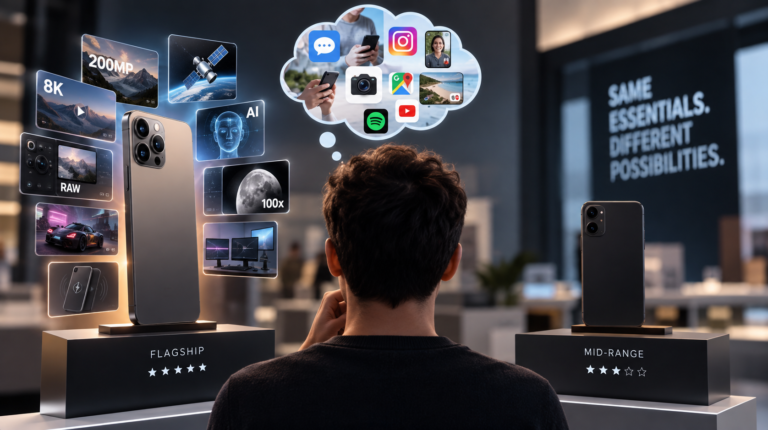
A smartphone can offer 8K video recording, advanced AI editing, RAW photography, desktop modes, extreme zoom and dozens of specialized settings. Most buyers will probably use only a fraction of them.
And yet, these features can still help sell the phone.
That may sound contradictory. If customers rarely use a feature, why should it influence what they buy? The answer lies in the difference between usage value and perceived value. Consumers don’t evaluate a product only by what they will realistically do with it every day. They also respond to what the product appears capable of doing.
Targeted.gr analyzes why smartphone features can become powerful marketing tools even when many buyers rarely use them, and how specifications, comparisons, future possibilities and premium positioning influence perceived value before the phone is even purchased.
Περιεχόμενα
ToggleWe don’t buy smartphones based only on what we do today
Ask someone how they use their smartphone and the answer will usually sound relatively ordinary. Messaging, social media, browsing, photography, maps, streaming, banking and a handful of frequently used apps cover a large part of everyday activity.
Now ask the same person what they want from their next smartphone.
The conversation often changes.
They may want a much better camera, more storage, stronger performance, advanced AI capabilities or professional video features. Perhaps they want a phone that can handle demanding games even though they rarely play them. They may want RAW photography despite never having edited a RAW file before.
This isn’t necessarily irrational.
When people buy an expensive device that they expect to keep for several years, they aren’t purchasing only for their current behavior. They’re also buying for possible future needs.
Marketing operates very effectively inside that gap between what we currently use and what we imagine we might use.
A feature can create value before it is ever used
Consider a phone with satellite connectivity.
For most owners, it may never become part of their normal routine. Ideally, they may never need to use it at all.
Yet its existence can still influence how the product is perceived. The device may feel safer, more advanced or more complete because the capability is available.
The same principle applies to many less dramatic features.
A buyer may never record an 8K video, but knowing the phone can do it reinforces the idea that its camera system is powerful. Someone may never connect their smartphone to an external monitor, yet desktop functionality can make the device appear more versatile.
In other words, a feature doesn’t always need frequent usage to generate perceived value.
Sometimes knowing that something is possible is enough.
Specifications turn complicated products into simple comparisons
Smartphones are extraordinarily complicated products.
Camera quality depends on sensors, lenses, image processing, stabilization, software and many other variables. Performance depends on far more than the name of the processor. Battery experience cannot be understood simply by comparing capacity.
Consumers, however, need manageable ways to compare products.
Specifications provide them.
200MP sounds larger than 50MP.
512GB sounds better than 256GB.
120Hz sounds better than 60Hz.
8K sounds more advanced than 4K.
Those comparisons are easy to understand even when they don’t tell the whole story.
This gives specifications enormous marketing power. They convert complicated engineering differences into numbers and labels that can be communicated within seconds.
The biggest number often becomes the easiest story
Imagine trying to advertise that a new smartphone has slightly better thermal management, more consistent image processing and carefully optimized background memory behavior.
All three improvements could meaningfully affect everyday experience.
They’re also difficult to explain in a billboard, social media advertisement or retail comparison card.
Now compare that with:
200MP Camera.
The message is immediate.
This is one reason smartphone marketing repeatedly gravitates toward large numbers and distinctive features. They compress complicated technological stories into something consumers can quickly remember.
That doesn’t automatically make the number meaningless. A 200MP camera can have legitimate technological advantages depending on its implementation.
The marketing advantage, however, exists independently of whether the average buyer understands those advantages.
The number itself becomes the message.
More features can make a product feel more valuable
Suppose two smartphones cost approximately the same amount.
One advertises a conventional camera system, standard video recording and familiar software tools.
The other advertises advanced AI editing, professional camera controls, extreme zoom, desktop functionality, reverse wireless charging and multiple additional capabilities.
Even if you expect to use only two of those features, the second product can feel as though you’re receiving more for your money.
This is where perceived value becomes important.
Consumers don’t always calculate value by counting how many times each feature will be used. They can also judge the product as a complete package.
A long list of capabilities makes the package appear richer.
And in highly competitive categories, perceived completeness can become a significant advantage.
Flagship features help justify flagship prices
The challenge becomes even greater at the top of the market.
A premium smartphone needs to explain why it costs considerably more than a capable mid-range alternative.
Performance matters. Cameras matter. Displays, materials and software support matter.
But those differences aren’t always immediately visible to somebody looking at two devices on a website.
Features provide additional evidence.
The flagship doesn’t merely have a better camera. It offers professional video controls, advanced zoom, RAW capture and AI editing.
It doesn’t simply have a powerful processor. It can run demanding games, process complex AI tasks or support desktop-like workflows.
Each capability contributes another small argument for the higher price.
Collectively, those arguments help construct a premium proposition.
The possibility of becoming a power user is attractive
There is another psychological dimension that smartphone marketing can tap into.
People don’t always buy products that reflect exactly who they are today. Sometimes they buy products that reflect who they imagine themselves becoming.
A sophisticated camera system creates the possibility of taking photography more seriously.
Professional video controls create the possibility of becoming a creator.
Advanced productivity features suggest that the smartphone could become part of a more efficient workflow.
A powerful gaming processor suggests that demanding games are available whenever the owner wants them.
The buyer may never fully become that imagined power user.
But the possibility itself can influence the purchase.
This phenomenon extends far beyond smartphones. Fitness products, professional cameras, cars, laptops and countless other categories are frequently marketed around capabilities that exceed the buyer’s everyday requirements.
We often purchase not just utility, but potential.
“I might need it someday” is a powerful argument
Future-proofing is closely connected to this idea.
When consumers spend significant amounts of money on technology, they naturally want to avoid feeling that their purchase will become inadequate too quickly.
An advanced feature can therefore function almost like insurance against future regret.
Maybe you don’t need it now.
But what if you need it next year?
What if you start creating videos?
What if your job changes?
What if a new app takes advantage of that hardware?
This can make the absence of a feature feel more significant than its actual probability of use would suggest.
The buyer isn’t necessarily asking:
“Will I use this every week?”
They may instead be asking:
“Will I regret not having it?”
That is a very different purchasing calculation.
Comparison pages amplify small differences
Smartphone shopping increasingly happens through comparison.
Consumers watch YouTube reviews, browse specification databases, read buying guides, compare retailer pages and open multiple tabs before making a decision.
Inside this environment, every difference becomes visible.
One phone supports something.
Another doesn’t.
One offers a particular camera mode.
Another lacks it.
One has a higher number.
Another has a lower one.
A capability that would barely matter during everyday ownership can suddenly appear extremely important while two products are being compared side by side.
This creates an interesting marketing paradox:
The feature may matter most before the purchase and least after it.
During shopping, it differentiates the products.
After purchase, the owner may rarely think about it again.
Review culture makes unusual features disproportionately visible
Technology reviews create another incentive for manufacturers to develop highly demonstrable features.
Reviewers need differences to discuss.
Creators need things to test.
Headlines need hooks.
A new smartphone that is simply “slightly better at everything” is difficult to communicate. A smartphone that introduces an unusual camera capability, AI tool or new interaction provides an obvious story.
That feature can then dominate launch coverage even if it represents a tiny percentage of how owners will eventually use the device.
This doesn’t mean reviewers artificially create its importance. New and unusual capabilities are naturally worth examining.
But the result is that highly demonstrable features receive disproportionate attention during the period when consumers are deciding what to buy.
That visibility itself has marketing value.
Social media makes visual features even more valuable
The effect becomes stronger on social platforms.
A battery optimization improvement is difficult to demonstrate in a 20-second video.
Extreme zoom is easy.
A more reliable modem isn’t particularly exciting on Instagram.
Removing a person from a photograph with AI is.
Small improvements to long-term software stability rarely go viral.
A dramatic before-and-after image can.
Features that produce visible transformations therefore have an advantage in the modern attention economy.
They aren’t necessarily more useful.
They’re simply more shareable.
And shareability can dramatically increase the amount of free exposure a product receives.
Halo features can influence how we judge the entire phone
One exceptional capability can also affect the perception of everything around it.
If a smartphone becomes known for an extraordinary camera feature, consumers may begin to perceive the entire camera system as superior.
If a device becomes associated with advanced AI, the whole product can feel technologically ahead of competitors.
This is the logic behind a halo feature.
The feature doesn’t have to represent everyday usage. Its role is partly symbolic.
It gives the product an identity.
And identities are extremely valuable in markets where competing devices increasingly offer similar baseline experiences.
A feature can sell the brand, not just the phone
The marketing impact can extend beyond an individual model.
A manufacturer that repeatedly introduces ambitious capabilities can develop a reputation for innovation.
Consumers may never use every experiment the company releases, but those experiments influence the brand image.
The message becomes:
This is the company pushing smartphone technology forward.
That perception can affect future purchases even when the buyer eventually chooses a completely different model from the same manufacturer.
A flagship therefore has another role beyond generating direct sales. It can function as a technological showcase for the brand.
Some of its most advanced capabilities are selling an idea about the company itself.
The feature list also reduces perceived compromise
Buying technology involves trade-offs.
Perhaps one phone has the better camera but another has better battery life. One has stronger performance while another provides longer software support.
Consumers rarely find a product that dominates every category.
A long feature list can nevertheless reduce the feeling of compromise.
Even when the buyer won’t use everything, seeing that the device supports many different scenarios creates reassurance.
The purchase feels safer.
This becomes particularly valuable for expensive products because buyers want to minimize post-purchase doubt.
Nobody wants to spend flagship money and immediately discover something their phone cannot do.
Fear of missing out can matter more than expected utility
This is where feature marketing can become especially powerful.
Imagine choosing between two devices when only one includes a particular capability.
You may know that you probably won’t use it.
But choosing the phone without it means permanently giving up the option.
That can make the missing feature psychologically uncomfortable.
The potential loss becomes more visible than the realistic utility.
This doesn’t mean consumers are being manipulated every time they choose the more capable device. Features genuinely provide flexibility.
But marketers understand that the fear of lacking a capability can sometimes be more persuasive than the promise of using it regularly.
Why don’t manufacturers simply focus on the basics?
This raises the obvious question.
If battery life, reliability, camera consistency, display quality and software performance affect everyday users more often, why not concentrate almost entirely on those areas?
Manufacturers already invest heavily in them.
The problem is that improvements to mature technologies become progressively harder to communicate.
Making a good display slightly better doesn’t create the same obvious narrative as introducing something entirely new.
Adding another hour of practical battery life is useful, but it may not visually differentiate a device during a launch.
Innovation therefore operates on two levels.
Companies need to improve the things people already use while simultaneously creating new reasons for consumers to pay attention.
Features often serve that second role.
The Athens Pulse question comes before the marketing question
There is also a broader technological reason why feature lists continue to expand.
Modern flagship smartphones combine increasingly powerful processors, sophisticated camera systems, specialized AI hardware and complex software platforms. Once that capability exists, manufacturers naturally explore new ways to use it.
Athens Pulse examines this broader side of the story in “Why Do Expensive Smartphones Still Come With Features Most People Never Use?”, looking at why flagship devices continue accumulating advanced capabilities even when many owners may barely explore them.
The distinction is important.
The Athens Pulse question is:
Why do these features keep appearing?
The Targeted.gr question is:
Why can those features help sell the product even when usage remains limited?
Technology creates the capability.
Marketing helps turn that capability into perceived value.
But more features can eventually become a problem
There is a point where the strategy begins to work in reverse.
Too many features can make a product confusing. Software becomes crowded. Settings multiply. Development becomes more expensive and users may struggle to understand what actually differentiates one version from another.
At that point, additional capability can stop strengthening the value proposition and begin weakening it.
This is not simply a marketing problem. It becomes a product and business strategy problem.
Market Insiders will examine that side of the discussion in “The Feature Creep Problem: When More Product Features Stop Creating Value” exploring what happens when companies continue expanding products after additional functionality stops producing proportional customer value.
The most successful product isn’t necessarily the one that can do the greatest number of things.
Sometimes it is the one that knows which things are worth doing exceptionally well.
The buying decision should eventually return to the user
For marketers, features can create differentiation, perceived value and attention.
For consumers, the calculation should be different.
A spectacular feature is valuable only in relation to the person buying the device.
Professional video tools can be transformative for one user and irrelevant to another. Extreme gaming performance may justify a purchase for somebody who plays demanding titles every day while adding little value for someone who primarily uses messaging and social media.
This is why specification comparisons should eventually lead to a more personal question.
Not:
“Which smartphone has the most features?”
But:
“Which features will actually improve the way I use my smartphone?”
Techrow.gr will approach the same issue from the buyer’s perspective in “Which Flagship Smartphone Features Do You Actually Need?”, separating genuinely useful premium capabilities from features whose value depends heavily on individual usage.
Marketing can make possibilities attractive.
The buying decision still needs to determine which possibilities are worth paying for.
Features sell possibilities, not only functions
This is ultimately why rarely used smartphone features can remain powerful selling points.
Consumers aren’t evaluating only what a phone does during an average Tuesday afternoon. They’re evaluating what it represents, what it might allow them to do later and how complete it feels compared with alternatives.
A feature can therefore create value in several different ways.
It can solve a practical problem. It can differentiate the product. It can support premium pricing. It can reduce fear of future limitations. It can generate attention. It can reinforce the brand’s reputation. And sometimes it can simply make the buyer feel that they are choosing the more capable device.
None of those outcomes requires the feature to be used every day.
That doesn’t mean more is always better. Eventually, feature accumulation can create complexity rather than value.
But it does explain one of the strangest characteristics of modern technology marketing:
Sometimes the feature that helps sell the smartphone isn’t the feature the owner will use most.
It is the feature that makes them imagine everything the smartphone could do.
Frequently Asked Questions
Why do smartphone brands advertise features most people rarely use?
Rarely used features can still differentiate a smartphone, reinforce its premium positioning and increase perceived value. They can influence the buying decision even if they later become a small part of everyday usage.
Why are smartphone specifications so important in marketing?
Specifications make complicated products easier to compare. Numbers such as megapixels, storage capacity, refresh rates and charging speeds give consumers simple reference points when evaluating competing devices.
What is a halo feature in smartphone marketing?
A halo feature is a distinctive capability that attracts attention and influences perception of the entire product. Extreme camera zoom, advanced AI tools or unusual productivity features can help a smartphone become associated with innovation even when relatively few owners use them regularly.
Do consumers buy smartphone features they don’t need?
Sometimes. Buyers can value future possibilities, flexibility and the reassurance of having a capability available even when they don’t currently need it. The fear of regretting a missing feature can also influence purchasing decisions.
Does having more features make a smartphone better?
Not necessarily. Additional features can increase versatility, but they can also introduce complexity. The practical value of a feature depends on how useful, accessible and relevant it is to the individual user.
Which smartphone features are actually worth paying for?
That depends heavily on usage. Camera capabilities may matter most to creators, sustained performance to gamers and software support or battery life to long-term users. Rather than counting features, buyers should identify which capabilities will meaningfully improve their own everyday experience.

Γεννημένος στην Αθήνα, στις αρχές της δεκαετίας του ’90, έχοντας ήδη πατήσει τα 30, ο υποφαινόμενος, με σπουδές στην Ψυχολογία, παραμένει ανήσυχος, ανικανοποίητος, λάτρης της συνεχούς αναζήτησης, μανιώδης συλλέκτης αντικειμένων που σχετίζονται με τις προσφιλείς του δραστηριότητες.